 UNIQ
Oct 8, 2026
Container and Kubernetes security: the layer growing faster than its governance
Containers and Kubernetes changed how fast software gets delivered — and most security programs still run at the pace of the infrastructure that replaced.
Containers and Kubernetes didn't just change the technology behind an application — they changed the pace at which it gets built, deployed, and discarded. A workload that used to live for months on a physical server can now live for minutes, recreated dozens of times a day by an automated pipeline. Most security programs still run at the pace of the old infrastructure: monthly scan, quarterly patch, semi-annual configuration review.
That speed mismatch is, today, one of the most common and least discussed gaps at any technology or SaaS company that adopted containers as its development standard.
The base image is inheritance, not a neutral starting point
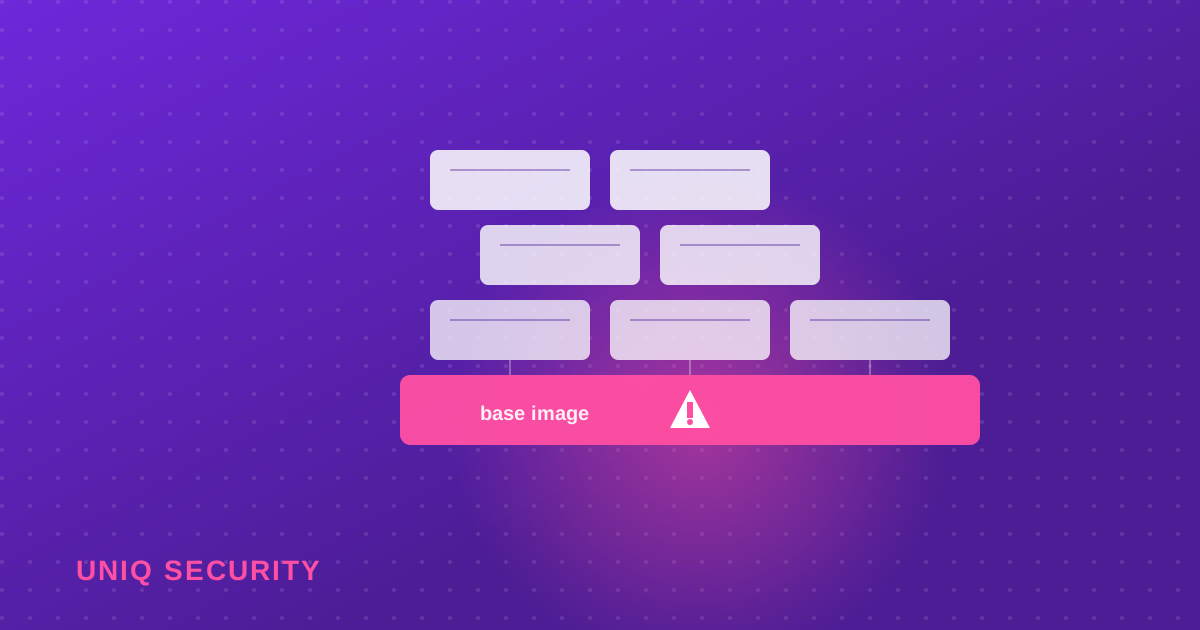
Every container image is built on top of a base image — and any vulnerability present in it is silently inherited by every container built from that point on. An outdated or never-audited base image, used as the default across dozens of different services, multiplies the same risk at scale, long before any of the application's own code enters the picture.
Treating the choice and upkeep of a base image as a central security decision — not a build-configuration detail — is what keeps a known vulnerability from becoming a pattern replicated across the entire stack.
RBAC and network policy: where Kubernetes misconfiguration shows up most
Two points concentrate most of the misconfiguration in a Kubernetes cluster: role-based access control (RBAC) granted too broadly to a service account, and the absence of network policy limiting pod-to-pod communication. Without those two layers well designed, a single compromised container has a free path to move laterally across the entire cluster — the same principle behind why cloud misconfiguration is a process problem, not just a tooling one, applied to the container orchestration layer.
An over-privileged service account in a CI/CD pipeline is part of the same broader problem of non-human identity without clear governance — and in a Kubernetes environment, those identities operate at an even larger volume than in traditional infrastructure.
An image scanner doesn't see runtime behavior
Scanning an image before deployment catches known, cataloged CVEs — and it's a necessary control. What it doesn't catch is behavior: a compromised dependency making an unexpected network call, a process attempting privilege escalation once the container is already running, a legitimate container being used anomalously by an attacker who has already gotten in.
That kind of threat only shows up to whoever monitors runtime behavior, not just the image's static contents — the same gap that, in a mature cloud posture platform, should be covered by the workload protection layer, not left out by treating a container as just another build artifact.
The image scan ends where the real risk begins
Mature container and Kubernetes security covers three moments — image, cluster configuration, and runtime behavior — not just the first one. UNIQ helps technology and SaaS companies close that full coverage, within the Exposure & AppSec portfolio sized to engineering's actual delivery pace. Talk to the technical team before pipeline speed is what exposes the gap.